

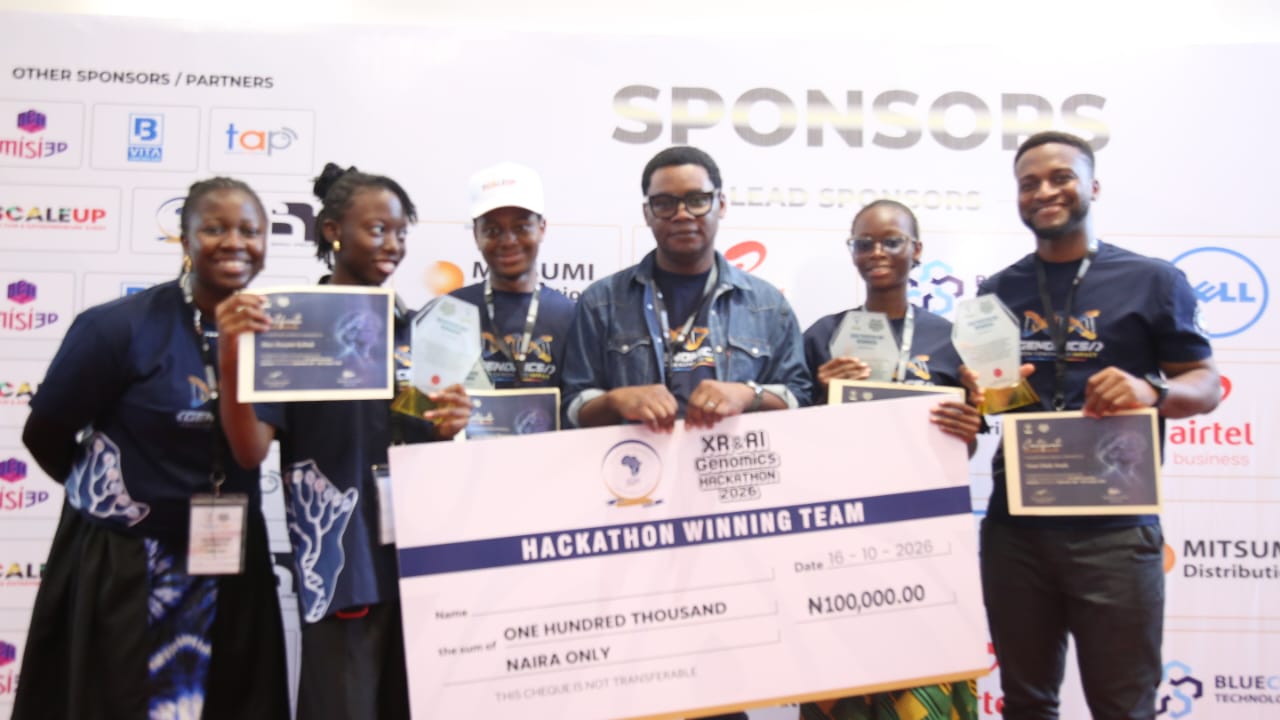
From Genome to Headset: 5 Nigerian Students Shine as They Replicate a Tough Lab Procedure into a Virtual Reality Headset.
 The biggest Genome Center in Africa hosted its second edition of the XR & AI Genomics Hackathon after the first-ever edition outside of Africa. At this hackathon, we have five teams of young scientists and coders (Unity Developers) and 3D artists who have just done what many Nigerian universities still consider futuristic – they built virtual reality prototypes to teach one of genomics’ most complex procedures to our VR lab at the Institute of Genomics and Global Health in Redeemer’s University, Ede, Osun State.
The feat was achieved at the 2026 XR & AI Genomics Hackathon hosted by the Institute of Genomics and Global Health, IGH, at Redeemer’s University, where participants were tasked with transforming the polymerase chain reaction, PCR, from textbook abstraction into an immersive experience.
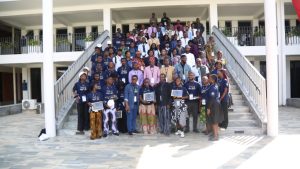 Held under the theme “From Genome to Impact: XR and AI Solutions for African Health”, the three-week-long programme ran from September 28 to October 16, 2026, and climaxed with a Demo Day at the IGH Auditorium that drew over 196 registered participants and 1,000+ online participants streaming the event, including industry leaders and academics experts.
The hackathon is the 2nd in the series, following its inaugural 2025 edition regarded as Africa’s first XR and AI genomics hackathon, and it forms a critical plank of IGH’s ambitious GenomicsXR project, a virtual reality platform designed to democratise access to genomics training.
For an ecosystem where limited laboratory infrastructure continues to hamper science education, the initiative raises a pertinent question: can extended reality fill the gap where physical lab benches fail?
At the heart of GenomicsXR is a simple but disruptive idea. Its first module on DNA extraction was deployed in 2025. The 2026 edition advanced that frontier by deconstructing PCR — the technique for amplifying selected DNA segments — into five teachable stages, each assigned to a separate team.
This modular approach, organisers said, was deliberate. Rather than one team building an entire PCR workflow, specialisation would ensure scientific accuracy and better user experience, while creating a feeder pipeline for the final product.
The execution was as technical as it was collaborative. Teams worked remotely at first, learning Unity for interactive development and Blender for 3D modelling, then moved onsite to test their builds in IGH’s VR lab using headsets that revealed flaws invisible on computer screens.
What emerged were five distinct prototypes: Team One built the history and principles of PCR with timelines and animations; Team Two modelled equipment and reagents, including personal protective equipment; Team Three tackled master mix preparation with safety checks and calculation quizzes; Team Four simulated the PCR plate setup, and Team Five developed the load-and-run stage with a virtual PCR machine.
At Demo Day, judged by Prof. Adeleke Osho, Provost of the Postgraduate School, Redeemer’s University, and Prof. Adewale Ogunde of Computer Science, Team Five emerged as the overall winner, followed by Team Two and Team Three in second and third positions, while Team Four and Team One finished fourth and fifth.
Beyond the competition, the event offered a sobering reflection on Africa’s place in genomics. Delivering the keynote, Emeka Odibeli, General Manager of PLLI, warned that technology must not become an end in itself but a tool to solve contextual health problems.
That message was reinforced by IGH Director, Prof. Christian Happi, and Deputy Directors, Prof. Folarin Onikepe and Prof. Anise Happi, who stressed the urgent need for African representation in genomic data, capacity building for personalised medicine, and locally-driven innovation.
Yet for all its promise, the project faces a critical test. The five prototypes remain fragmented, and IGH admitted that significant work is still required to connect them into a single, scientifically validated and user-tested learning experience before it can be deployed at scale.
The programme was convened by Adedayo Okunfolami, CITIO at IGH, with Gaffar Ibrahim, Creative XR Developer and Teams Coordinator, Caleb Kiri, IT Support Coordinator, and Isaiah Abiodun Christopher, Science Communicator, playing key roles in mentoring the cross-disciplinary teams.
Sponsors including Dell Technologies, Airtel Business, Bluechip Technologies, Mitsumi Distribution, Touch and Pay Technologies, Imisi 3D, ScaleUp, Vita Construction, BaayProject and Leather and Rubber Universe backed the initiative, which IGH says will continue through monthly XR-Continuum community meetups.
If successful, GenomicsXR could signal a shift in how African universities preserve genomics knowledge and train the next generation – not just with pipettes and petri dishes, but with headsets, code and immersive storytelling built for Africa’s health challenges.
Leave feedback about this